Wednesday, September 6, 2017

Lifestyle Changes Can Reduce Dementia Risk, Study Says


Nine lifestyle changes can reduce dementia risk, study says

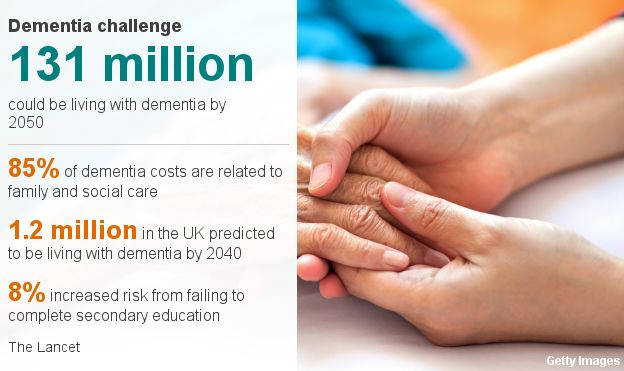
One in three cases of dementia could be prevented if more people looked after their brain health throughout life, according to an international study in the Lancet.

It lists nine key risk factors including lack of education, hearing loss, smoking and physical inactivity.

The study is being presented at the Alzheimer's Association International Conference in London.

By 2050, 131 million people could be living with dementia globally.
There are estimated to be 47 million people with the condition at the moment.

Nine factors that contribute to the risk of dementia

Mid-life hearing loss - responsible for 9% of the risk
Failing to complete secondary education - 8%
Smoking - 5%
Failing to seek early treatment for depression - 4%
Physical inactivity - 3%
Social isolation - 2%
High blood pressure - 2%
Obesity - 1%
Type 2 diabetes - 1%

These risk factors - which are described as potentially modifiable - add up to 35%. The other 65% of dementia risk is thought to be potentially non-modifiable.


Although dementia is diagnosed in later life, the brain changes usually begin to develop years before," said lead author Prof Gill Livingston, from University College London.

"Acting now will vastly improve life for people with dementia and their families and, in doing so, will transform the future of society."

The report, which combines the work of 24 international experts, says lifestyle factors can play a major role in increasing or reducing an individual's dementia risk.

It examines the benefits of building a "cognitive reserve", which means strengthening the brain's networks so it can continue to function in later life despite damage.

Eve Laird, from Dumfries, is worried about dementia because her mum is living with the condition.

She has decided to make some changes to her lifestyle.

"I'm terrible for eating processed foods and takeaways and I've really been trying to cut back on that.
"I definitely drink a lot more water than I used to - and I don't drink as much coffee now.
"I actually took part in the Edinburgh marathon. For that I joined the Dumfries running club - I go there once a week."
She says she felt so much better for the exercise, and for improving her diet.
"I felt a lot healthier and mentally sharper as well. It's something I'd really like to continue, but it is hard to stay on track."
"I just think the small changes can make such a big difference."

Failure to complete secondary education was a major risk factor, and the authors suggest that individuals who continue to learn throughout life are likely to build additional brain reserves.

Another major risk factor is hearing loss in middle age - the researchers say this can deny people a cognitively rich environment and lead to social isolation and depression, which are among other potentially modifiable risk factors for dementia.

Another key message from the report is that what is good for the heart is good for the brain.

'Positive changes'
Not smoking,
doing exercise,
keeping a healthy weight,
treating high blood pressure and diabetes can all reduce the risk of dementia, as well as cardiovascular disease, and cancer.

The researchers say they did not have enough data to include dietary factors or alcohol in their calculations but believe both could be important.

Dr Doug Brown, director of research at Alzheimer's Society, said:

"Though it's not inevitable, dementia is currently set to be the 21st Century's biggest killer. We all need to be aware of the risks and start making positive lifestyle changes."

Dr David Reynolds, chief scientific officer at Alzheimer's Research UK, said: "Alongside prevention research, we must continue to invest in research to find a life-changing treatment for people with this devastating condition."

Physician Well-being: A Critical Missing Link in Medical Education


Physician Well-being: A Critical Missing Link in Medical Education


At the Southern California Permanente Medical Group (SCPMG), the physician-led care delivery system that partners exclusively with Kaiser Foundation Health Plan and Hospitals in Southern California, we are committed to helping solve physician burnout and see this as a critical aspect of transforming health care in America.


Practicing medicine today is far more demanding and multifaceted than when I began my practice in 1984 as a family physician at Kaiser Permanente. 


Medicine has made remarkable progress in technology and outcomes, but advances have come with a price for physicians.


Doctors are experiencing greater stress due to a myriad of causes: Long hours, loss of autonomy, complex and often inefficient systems, and additional time-intensive responsibilities such as maintaining electronic medical records, diagnostic coding, regulatory compliance and administrative duties.


This stress is compounded by personal attributes of self-sacrifice, hyper-accountability, perfectionism, challenges with boundary setting, and equating asking for help as weakness. 


Altogether, this too often leads to poor work-life integration and burnout for physicians.


In their noble calling to take the best possible care of their patients, many physicians put their own well-being at risk.


Physician Burnout on the Rise


Physician burnout in the U.S. is rising at an alarming rate. A survey by the Mayo Clinic revealed that from 2011 to 2014, physicians experiencing at least one symptom of burnout rose from 46% to 54% – a much greater level than in other professions. Of those surveyed, 39% experienced depression, increasing the risk of suicide.  


At SCPMG, I have made physician wellness a key focus of our vision to help transform health and health care in America.


I began by asking our physicians how they viewed our culture of health. The initial results were not encouraging.


This led to my appointing a Physician Chief Wellness Officer. In four short years,


Dr. Dawn Clark has helped lead the creation of a robust physician wellness program that provides support, knowledge and tools to help physicians better manage their busy lives and embrace their own health and resilience.


Second Victim Syndrome (the burden providers feel after an adverse patient outcome) and peer-to-peer support groups have been formed and provide emotional support to colleagues.     


 However, this is just one part of the equation. Leaders in health care must take ownership for the creation of a wellness culture that supports physician health along with the design of efficient systems and workflows that maximize a physician's unique contributions to patient care.


Bureaucracy and inefficiency in care delivery systems must be addressed. 


Some of the systemic changes we’ve made since our program began include workflow redesigns that off-load clerical work from physicians, help physicians manage email volume through support staff, and train doctors on using our electronic medical records system with greater ease and efficiency.


We also have worked to increase availability of alternate and flexible schedules to better meet the needs of physician work-life integration. 


As a result of this work, a recent survey of our physician colleagues indicates significant improvements in how doctors view our wellness culture since the initial survey three years ago. Physician ratings of key workplace “culture of health” measures improved by a range of 11-23 percent. Although we are making progress, there is more work to be done.


For Many, Burnout Begins in Medical School


Part of the solution to achieving greater physician wellness and resilience lies in influencing the medical culture in America further upstream – in medical school. 


For physicians, asking for help when we are stressed is counter to what we have been taught, consciously or otherwise: That to be a good physician, we must be superhuman, self-sacrificing care providers, able to work long hours while putting our patients’ needs before our own.


A study published in Academic Medicine in 2014 concluded that students entering medical school have better mental health indicators than age-similar college graduates in the general population.


However, by graduation, the mental health, resilience, and optimism of medical students have declined.


Anyone who has attended medical school understands some of the contributing factors: Long hours spent studying volumes of information; the unrealistic pressure to be perfect; the emotional impact of dealing with death and dying; a fear to admit that one may need help with mental health issues; inadequate boundary setting; and feelings of isolation.


Recognizing and addressing causes of burnout can potentially alleviate depression and prevent suicide, not only in medical school but throughout one’s career.


To do so will require providing students with emotional resilience tools that they can use throughout medical school and beyond, making it safe to talk about their struggles and ensuring that effective mental health resources are available when needed.


A Different Kind of Medical School


Kaiser Permanente is planning a national school of medicine in Pasadena, California with a curriculum that will incorporate new ways of training doctors.


It is our intention to establish a learning environment and curriculum that supports, teaches and models well-being and resilience – skills and techniques that students can employ throughout their careers as physicians.


Our physician-led school will embrace a holistic approach not only toward curriculum development and mentoring, but in helping students achieve resilience and a healthy lifestyle in body, mind and spirit.


We have designed the new facility to include space for socialization, a rooftop meditation area, a yoga garden and a fitness center, so the school will be a convenient place to practice what we teach.


A demonstration kitchen on campus will be a place for students to learn about nutrition, and how to prepare their own healthy meals.


The curriculum will emphasize the importance of sleep and encourage students to find a personal exercise regimen to promote fitness and reduce stress. They will learn that it's okay to ask for help and be connected to mental health resources. 


Connecting students to their purpose will also be key.


As a school that reflects Kaiser Permanente’s values of diversity, inclusion, health equity and community health, our students will be connected to the meaning of what they do through aligned curriculum and experience, engaging with patients and the communities we serve. 


We will teach students change management and how to work effectively within systems of care -- to be both leader and effective team member -- so as physicians they can be agents of change in improving the care delivery systems in which they practice.


Most importantly, our intent is to create a culture that declares that physician wellness matters. In fact, physician wellness is essential if we are to have healthy patients and an effective health care system in America.


Burnout and poor physician wellness can negatively affect quality of care, patient satisfaction, medical errors and malpractice risk, as well as turnover of staff and early physician retirement. 


We need strong and resilient physicians to lead the needed transformation of health and health care in our country.


Finding Solutions


This past April, The Kaiser Permanente School of Medicine invited medical students, medical educators and leaders from across the country to brainstorm about how to shift the paradigm of medical education towards supporting and sustaining greater levels of well-being and resilience for students.


The convening began with a tour and dinner at the Association of American Medical Colleges (AAMC). 


Several members of the AAMC attended and participated in the conference, including the president and CEO of the AAMC, Darrell G. Kirch, MD.


I was honored to give the keynote address and participate in the ensuing discussions. I began my talk by asking the audience a somber question: “How many of you were aware of a fellow student committing suicide in medical school?” Sadly, about half the room, including me, raised our hands.


The mood became more optimistic throughout our conference as we brainstormed a list of root causes and declared a commitment to find solutions for mitigating burnout in medical school and beyond. 


We ended the day with a sense of hope and renewed purpose, and yet we were aware that this is just the beginning.


I invite all who see themselves as stakeholders in creating both the culture and structure that fosters greater physician resilience and well-being to join our continuing conversation to solve for physician burnout in our country.


Dr. Ed Ellison believes Permanente Medicine and Kaiser Permanente’s coordinated, integrated model of high-quality, affordable care provides an answer to health, health care and physician wellness in America. In his effort to achieve wellness, Dr. Ellison enjoys time with family, favors a plant-based diet, tries to get enough sleep, and always takes the stairs.

Source:         Linkedin
Friday, September 1, 2017

10 Unusual Ways to Release Oxytocin Into Your Life


Written By James Altucher


I disgust myself.

When I was six I used to make fun of one kid for being heavier than me.

When I was seven I made fun of a kid for being Chinese. He was the only Chinese kid in the neighborhood. I was a seven year old racist. He was so upset the principal had to talk to me.

The punishment – we had to ride with each other on the bus every day. He was more upset than me about this.

When I was nine I was caught shoplifting football cards. This after a successful crime career lasting for about a year where I had stolen everything from candy to Charlie Brown books to Mad books to baseball cards.

My parents were so angry they cancelled my birthday party that was coming up. Then they never let me have one again.

I still don't have birthday parties. Because I stole a football card.

I did lots of things. Things much later. Ugh. I can hardly think of it. The things that I would do.

I'm like a psychopath or sociopath when I really get down to it. Worst of all, I go to the bathroom. I've never seen a more disgusting thing than my own human body going to the bathroom. Ugh.

Google: I need to talk to you about this! You are making a car that drives without a driver. You are making glasses that wire my brain right into the Internet. Why the hell can't you make it so I don't have to shit.

Like, can't I wear glasses that do photosynthesis from the sun and turn into nutrition for my body. Nutrition with no waste. Why, for everything I eat, do I have to generate waste? This is almost proof that Satan exists.

And even worse, some of the waste gets stuck. If you're not yet my age (44) you'll start to know what I'm talking about. It gets stuck forever.

I've switched diets recently. No carbs. No processes sugars. Not even gluten-free stuff, which is all a scam. And, I have to say, the quality of what comes out of me has become much better. Nor do I feel as stuffed.

So, OK, glass half full. Right?

Let me tell you the real bad news, although it won't seem that way. Our alien ancestors who created us also created simple tools (call them "triggers" if you will) so that we can reprogram our bodies to be happy.

What does happy mean? It means various chemicals get manipulated throughout the body. Cortisol levels go down. Cortisol is the "fight or flight" hormone.

So, like, when you are sitting at your desk staring at a computer screen and you are worried your boss is going to yell at you, your cortisol levels are going through the roof.

In other words, your body wants to do what it would've done 20,000 years ago (a micro-second in our evolutionary history) and basically run as fast as possible or physically destroy whatever is scaring you. Fight OR flight. Note the "OR".

There really isn't an in-between that says, "don't move and simply stare at your computer screen while you are simmering in unrequited anger and frustration."

That wasn't part of the evolutionary plan. That's what the neanderthals did probably. And look at what happened to them. They're dead. Every last one of them.

So what do you do? In our modern day and age. You sit there, you stare at the computer screen, you maybe type some words but then your brain is distracted. You can't think. Your cortisol is through the roof and nothing is working it off.  That's really horrible. The cortisol needs to be worked off. Or else. You are royally *******.  You can get cancer, heart disease, strokes,
Alzheimers, the whole works.

And if you are like me, if you are like most people, then chances are this is happening to you every day.

Here's what happens.

The vagus nerve stretches from your brain to your stomach and hits every organ along the way (almost). It gets inflamed when your cortisol levels are too high for too long. The vagus nerve basically causes every disease known to mankind. High stress inflames it, as does bad food, smoking, etc.
You get the drift.

 What suppresses the inflammation?

Another hormone that the body is more than happy to release. Oxytocin.
Oxytocin performs two very important functions that allow the human race to continue. But these functions have various beneficial side effects.


Oxytocin is released when you have an orgasm. For men, interestingly, it is only released when you have an orgasm with someone you love.
Oxytocin is released when a woman is in labor. It helps the cervix stress so it's in less pain. It's released for women, that is. For men, when the female cervix starts to expand it's the beginning of about nine years of agony.

Basically, Oxytocin is the hormone that is there at the critical moments of life creation. It's the "life hormone."

It also helps reduce cortisol levels (you know that feeling of relaxation you get after sex) and it reduces inflammation of the vagus nerve. (I sort of like that word: "vagus." It's both "vague" and "vaginal").

So I'm not going to point to all the research. You can google it with your glasses. But basically, there's various ways you can trick the body into releasing oxytocin. The benefits are simple: you feel better and you will live longer and you will reduce stress and be happier.

Here are ten ways:


A) Give money away.

Turns out that showing compassion in a visceral way like giving money is linked to higher levels of oxytocin. My guess is that giving to charity is not the way to do it. I prefer my method of being a superhero that I write about in this post.

B) Hugging someone. 

Touching and hugging release oxytocin with hugging more powerful than touching and hugging someone you love even better than normal hugging.

So a hug is better than a handshake. But almost as good as hugging is imagining yourself being hugged or cuddled by someone you love.

Huh. It's really funny how the brain does that.    

C) Using facebook.

I like to browse my facebook timeline and occasionally "Like" a photograph that a random friend from 30 years ago posted. I would never in a Million years call that friend and say, "that was a real cute photo of your baby that you posted." But liking the photo is my way of connecting with someone that I have felt close to at some point in my life, even if it was only because her locker was next to mine in junior high school.

Guess what, using social media in this way turns out to release oxytocin.
You know you feel good when you do it. Do it more. IN particular, facebook like all of my blog posts. [The funny thing is, someone has actually done this scientific research and demonstrated it. Not the part about liking my blog posts but about facebook in general. Although liking my blog posts will certainly release Oxytocin. You can start now if you want.]

C) Laughter.

I will tell you my pre-date secret. In the brief period when I was single in between separation and re-marriage I had a technique before every date. I would watch either Michael Cera doing comedy or Louis CK doing standup.

This would get me laughing, make my oxytocin hormones go on fire, and then I'd go right into the date, with all my sex hormones raging. Plus. I would be temporarily funnier, with a half-life of about two hours. I knew after four hours I would be boring again so the date would have to be over by then. I do this before talks also.

D) Take a walk.

Note: I didn't say take a run. Running is great for reducing the metabolism but so is eating better. Else, for me at least, running is really hard. I hate it.
But I love to walk. Walk in the sun. The sun is a nutrient. And a half hour won't kill you, despite what global warming people say.

Walking outside, as you might guess, is statistically correlated with higher levels of oxytocin. Well, you say, I can't walk. I have meetings all day. If you can, try to take a walking meeting. This helps you bond more with the person you are meeting with, and you might even have an adventure along the way (guess what – scientific research shows that having an adventure with someone also releases oxytocin. I guess because then you know when you are chasing wolves with someone then you will feel safer).

The last time I had a walking meeting with a friend, a guy started yelling me from a car and I challenged him (with a smile on my face) to a fight. My friend had to drag me away while the guy was parking his car and getting ready to kill me. It was fun. It was an adventure. I felt thrilled. Several months later, I had a walking meeting with that same friend just yesterday.

E) Shoot guns. 

Call up a friend right now. Make an appointment at a gun gallery. And shoot guns. I don't know what to tell you. This releases oxytocin also.

F) Call someone. 

It's good to talk to a friend. I don't have a lot of friends. I have about three people on my call list. Maybe four if I stretch it. Maybe five. I don't know. Maybe 50.

I like a lot of people but I'm too shy to call them. But maybe I should. And just chat for a few minutes. Like we all used to do when we were kids. "Hey, how are you doing? What's up?" This feels good. It's like a vocal hug with someone we like. Vocally hug people today.

G) Being trusted.

This is hard. You can't force people to trust you. And trusting someone doesn't release oxytocin. But being trusted does. So live your life in such a way that more and more people will trust you.

Guess what: you will be viewed in a more charismatic way if people trust you than if people don't trust you. Why not try this? How can you be more trusted. Oh my god, why so many questions today? My hands are already tired. I'm about 1497 words already.

H) Listening to soothing music.

Just lying down and listening to music releases oxytocin. That's why women in labor are encouraged to listen to soothing music. That's why people having sex listen to soothing music.

I don't even really know what soothing music means. I keep thinking of the 90s rap group PM Dawn. But I'm sure there are better examples (Spandau Ballet?).

I) Trust me when I say this: 

Here is my Oxytocin-rich meal: eggs, mixed with bananas, with pepper.
Each ingredient known to release high levels of oxytocin.

So why not eat them all together: something sweet, something savory, something spicy, a fruit, some protein, its all good.

Eat a big plate of that and nothing else. BAM! You are off for the day on an oxytocin spurt.

And finally:

J) Deep breathing.

When the vagus nerve is inflamed your breathing becomes more shallow. It's fight or flight time! You are panicking. Your breath becomes quick. Stop it! Breathe deep.

Let me tell you something: most people think "yoga" is all those exercises where people are standing upside down and doing weird things. In the
Yoga Sutras, written in 300 BC, there are 195 lines divided into four chapters. In all those lines ONLY ONE LINE refers to physical exercise. It basically says, "be able sit up straight." That's it.

That's the only reference in the Yoga Sutras to physical exercise. Just as important is an area of yoga called pranayama which has to do with deep breathing.

Basically, yoga measures a lifespan in the number of breaths you take. A dog pants fast and dies young. A turtle breathes slow and lives to over 100.
Pranayama is the art of breathing slower and slower and using your cavities in your bodies other than your chest cavity to hold your breath (i.e. your abdomen, for instance).

You don't have to be a pranayama expert. I don't want to be one. But the simplest exercise is to sit there and hold your breath for 8 seconds, breath out for 8 seconds, breathe in for 8 seconds, hold, etc. Do that for ten minutes a day. They didn't say this in 300 BC but your oxytocin comes out to play during these moments. I could put links to all the scientific research on these things. But it's worth googling to check out if you don't believe me.


This is all good and bad news. The good news is that there is a chemical in your brain that when released, makes you feel good for up to two weeks. And if a lot of it is released you either feel like you are having an orgasm for two weeks or, I don't know, like your cervix is being expanded for two weeks. I have no idea on that one.

The bad news is exactly the same. A CHEMICAL will make you feel good for two weeks. In other words, our basic human bodies are no better than Pavlovian dogs – triggered to salivate when the right stimuli hits our 200,000 year old evolutionary brains. We're no better than the dogs. No better than the jellyfish that crawled out of the bottom of the ocean and then formed tentacles, then arms, then brains.

Forget all self-help. It's all garbage. It's all about this one silly chemical. The news lately is all about Higgs-Boson being the "god particle." Well, oxytocin is the "god hormone."

That said, I'll do all of the above. I need my body functioning. I need to get rid of mental waste and physical waste and emotional waste. Why not?

But at the end of the day it's spiritual waste that I'm after. And how do you get that? How do you get to that peculiar desire of trying to have no desires. Because when you expect nothing, you have the immense satisfaction of getting everything you want.

How do you get there?

It's not Oxytocin. I won't be fooled into believing it. But if it makes me shit out my mental and emotional waste better then sign me up.

Being happy is a good start. But oxyocin is just the flower. And you can't see the flower without the light. The goal is to be the light.