Showing posts with label Alzheimer's Disease. Show all posts

Wednesday, September 6, 2017

Lifestyle Changes Can Reduce Dementia Risk, Study Says


Nine lifestyle changes can reduce dementia risk, study says

One in three cases of dementia could be prevented if more people looked after their brain health throughout life, according to an international study in the Lancet.

It lists nine key risk factors including lack of education, hearing loss, smoking and physical inactivity.

The study is being presented at the Alzheimer's Association International Conference in London.

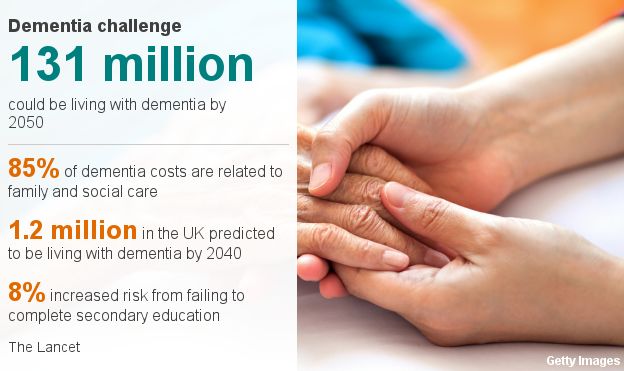
By 2050, 131 million people could be living with dementia globally.
There are estimated to be 47 million people with the condition at the moment.

Nine factors that contribute to the risk of dementia

Mid-life hearing loss - responsible for 9% of the risk
Failing to complete secondary education - 8%
Smoking - 5%
Failing to seek early treatment for depression - 4%
Physical inactivity - 3%
Social isolation - 2%
High blood pressure - 2%
Obesity - 1%
Type 2 diabetes - 1%

These risk factors - which are described as potentially modifiable - add up to 35%. The other 65% of dementia risk is thought to be potentially non-modifiable.


Although dementia is diagnosed in later life, the brain changes usually begin to develop years before," said lead author Prof Gill Livingston, from University College London.

"Acting now will vastly improve life for people with dementia and their families and, in doing so, will transform the future of society."

The report, which combines the work of 24 international experts, says lifestyle factors can play a major role in increasing or reducing an individual's dementia risk.

It examines the benefits of building a "cognitive reserve", which means strengthening the brain's networks so it can continue to function in later life despite damage.

Eve Laird, from Dumfries, is worried about dementia because her mum is living with the condition.

She has decided to make some changes to her lifestyle.

"I'm terrible for eating processed foods and takeaways and I've really been trying to cut back on that.
"I definitely drink a lot more water than I used to - and I don't drink as much coffee now.
"I actually took part in the Edinburgh marathon. For that I joined the Dumfries running club - I go there once a week."
She says she felt so much better for the exercise, and for improving her diet.
"I felt a lot healthier and mentally sharper as well. It's something I'd really like to continue, but it is hard to stay on track."
"I just think the small changes can make such a big difference."

Failure to complete secondary education was a major risk factor, and the authors suggest that individuals who continue to learn throughout life are likely to build additional brain reserves.

Another major risk factor is hearing loss in middle age - the researchers say this can deny people a cognitively rich environment and lead to social isolation and depression, which are among other potentially modifiable risk factors for dementia.

Another key message from the report is that what is good for the heart is good for the brain.

'Positive changes'
Not smoking,
doing exercise,
keeping a healthy weight,
treating high blood pressure and diabetes can all reduce the risk of dementia, as well as cardiovascular disease, and cancer.

The researchers say they did not have enough data to include dietary factors or alcohol in their calculations but believe both could be important.

Dr Doug Brown, director of research at Alzheimer's Society, said:

"Though it's not inevitable, dementia is currently set to be the 21st Century's biggest killer. We all need to be aware of the risks and start making positive lifestyle changes."

Dr David Reynolds, chief scientific officer at Alzheimer's Research UK, said: "Alongside prevention research, we must continue to invest in research to find a life-changing treatment for people with this devastating condition."

Sunday, April 30, 2017

Study Links Diet Soda To Higher Risk Of Stroke, Dementia


 Americans trying to stay healthy have abandoned sugary drinks for diet drinks in droves over the past few decades on the theory that the latter is better than the former.

Now, more evidence has emerged to refute that rationale.

Indeed, a new study shows an association between diet soda and both stroke and dementia, with people drinking diet soda daily being almost three times as likely to develop stroke and dementia as those who consumed it weekly or less.

“This included a higher risk of ischemic stroke, where blood vessels in the brain become obstructed and Alzheimer’s disease dementia, the most common form of dementia,” said Matthew Pase, a Boston University School of Medicine neurologist and the lead author of the study published in the journal Stroke.

While emphasizing that the research did not show causation, only a correlation, Pase said in a video explaining the study that diet drinks “might not be a healthy alternative.”

The study, described only as a hypothesis by its lead author was surrounded by caveats.

While the risk was greater, the absolute numbers were low. “In our study,” the lead author said, ” three percent of the people had a new stroke and five percent developed dementia, so we’re still talking about a small number of people developing either stroke or dementia.”

The lead author also noted its many limitations in an accompanying commentary from the American Heart Association:
The participants were overwhelmingly white, and it is possible that ethnic preferences may influence how often people select sugary or artificially sweetened drinks ….People did not drink sugary sodas as often as diet sodas, which Pase said could be one reason the researchers did not see an association with regular soda since the participants may have been health conscious and just not consuming them as frequently. The main limitation, Pase said, is the important point that an observational study like this cannot prove that drinking artificially-sweetened drinks is linked to strokes or dementia, but it does identify an intriguing trend that will need to be explored in other studies.

Still, people should be “cautious” about their intake of diet sodas, Pase said, noting that more study is needed.

And they should most definitely not retreat to sugary drinks, he said.

They have been associated not only with obesity and its consequences, such as diabetes, but with poorer memory and smaller overall brain volumes.

The study kept track of 2,888 individuals age 45 and over for the development of a stroke and 1,484 participants age 60 and older for dementia over a 10 year period. All are participants in the famous Framingham Heart Study, several thousand men and women who have had blood tests done periodically since the 1970s.

The study “found that those who reported consuming at least one artificially sweetened drink a day, compared to less than one a week, were 2.96 times as likely to have an ischemic stroke, caused by blood vessel blockage, and 2.89 times as likely to be diagnosed with dementia due to Alzheimer’s disease,” said a summary from the AHA.

The study “found that those who reported consuming at least one artificially sweetened drink a day, compared to less than one a week, were 2.96 times as likely to have an ischemic stroke, caused by blood vessel blockage, and 2.89 times as likely to be diagnosed with dementia due to Alzheimer’s disease,” said a summary from the AHA.

A parallel study of sugary drinks did not find an association with stroke or dementia.

The artificial sweeteners consumed by those in the study included saccharin, acesulfame-K, and aspartame. Other sweeteners, including sucralose, neotame and stevia have been approved by the FDA since, the study said.

The results were adjusted for variables such as age, sex, caloric intake, diet quality, physical activity and smoking. (For those seeking more detail, the study is downloadable in its entirety.)

“So, the bottom line is, ‘Have more water and have less diet soda,”

Christopher Gardner, director of Nutrition Studies at the Stanford Prevention Research Center, said in an AHA release. “And don’t switch to real soda.”

He added “Nobody ever said diet sodas were a health food.”

The AHA release quoted Rachel K. Johnson, professor of nutrition at the University of Vermont: “We need to be cautious in the interpretation of these results. It doesn’t prove cause and effect. When you see these kinds of associations, you want to always ask what is the biological plausibility, what is the mechanism that might be causing this?”
“We have a robust body of literature on the adverse effects of sugary drinks. Absolutely the message is not to switch to sugary drinks,” she said.


The American Beverage Association was quick to defend diet drinks.
“Low-calorie sweeteners have been proven safe by worldwide government safety authorities as well as hundreds of scientific studies and there is nothing in this research that counters this well-established fact,” it said in a statement. It added:

While we respect the mission of these organizations to help prevent conditions like stroke and dementia, the authors of this study acknowledge that their conclusions do not — and cannot — prove cause and effect.

This post has been updated and corrected. An original version said stevia was an artificial sweetener. In fact, it comes from a plant.

Source:     TWP

Thursday, December 29, 2016

The Power To Turn Back Time


Blood from human teens rejuvenates body and brains of old mice -The power to turn back time
Blood plasma from young people has been found to rejuvenate old mice, improving their memory, cognition, and physical activity. 
The method has the potential to be developed into a treatment for people, says Sakura Minami of Alkahest, the company behind the work.
 Previous research has found that stitching old and young mice together has an interesting effect. 
While sharing a blood system works out well for the older mouse, the younger one isn’t so lucky. The young animals started to show signs of brain ageing, while the brains of the older mice started to look younger. “We see a rejuvenation effect,” says Minami.
The key to youth appears to be in the blood plasma – the liquid part of blood. 
Several studies have found that injecting plasma from young mice into old mice can help rejuvenate the brain and other organs, including the liver, heart, and muscle.
Could blood plasma from young people have the same benefits? 
To find out, Minami and her colleagues took blood samples from 18-year-olds, and injected them into 12-month-old mice. At this age, the equivalent of around age 50 for people, the mice start to show signs of ageing – they move more slowly, and perform badly on memory tests.
The mice were given twice-weekly injections of the human plasma. 
After three weeks of injections, they were submitted to a range of tests. 
The treated mice’s performance was compared to young, 3-month-old mice, as well as old mice who had not received injections.
New neurons
They found that human plasma does have the power to rejuvenate. Treated mice ran around an open space like young mice. Their memories also seemed to improve, and they were much better at remembering their way around a maze than untreated mice.
“Young human plasma improves cognition,” says Minami, who presented her findings at the Society for Neuroscience annual meeting in San Diego, California, on Monday. “Their memory was preserved.”
“It’s more or less what we would expect,” says Victoria Bolotina, at Boston University in Massachusetts. “The blood of young people must have something in it that’s important for keeping them young,” she says.
The team then examined the brains of the treated and untreated mice. They looked for clues on the birth of new neurons in the hippocampus – a process called neurogenesis, which is thought to be important for memory and learning. Sure enough, the treated mice appeared to have created more new cells in their brain. “Young human plasma treatment can increase neurogenesis,” says Minami.
Minami says she has identified some factors in young blood that might be responsible for these benefits, but that she won’t reveal what they are yet. 
Some of them seem to be crossing into the brain, while others may be acting remotely, elsewhere in the body, she says.
She hopes to one day translate the findings into an anti-ageing treatment for people – one that might help those who start to experience the effects of an ageing brain. “There’s anecdotal evidence that people experience benefits after blood transfusions,” she says.
The company she works for, Alkahest, has already started a trial of young blood in people with Alzheimer’s disease.

By Jessica Hamzelou in San Diego

Source:     Facebook 


Friday, July 24, 2015

Sleep, Exercise May Help Battle Alzheimer's Disease


New research suggests poor sleep and a lack of exercise may increase people's risk of Alzheimer's disease, and make coping with the disease difficult after it has taken hold

Watch this video and listen to how sleep and exercise can help battle Aizheimer's Disease

It is important